Conference Paper
·
April 2026
·
London, UK
ARMARecon: ARMA Convolutional Filter Based Graph Neural Network for Neurodegenerative Dementia Classification
ISBI 2026
·
International Symposium on Biomedical Imaging · London, UK
Abstract
Standard GNNs applied to neuroimaging graphs suffer from over-smoothing and over-squashing — collapsing discriminative features and compressing long-range cortical dependencies. We present ARMARecon, which jointly addresses both failure modes via ARMA spectral filtering combined with reconstruction-driven regularisation, achieving 98.3% CN vs. MCI and 99.7% CN vs. AD accuracy on ADNI — more than 3% above GCN, GAT, and ChebNet baselines.
Motivation
- Graph Neural Networks offer a natural model for neuroimaging cohorts — subjects as nodes, neuroanatomical similarity as edges — but standard GNNs fail in clinically realistic small-cohort, sparse-label settings.
- Over-smoothing: repeated convolutions collapse all node representations toward the same embedding, destroying the subtle inter-subject FA differences that carry diagnostic signal.
- Over-squashing: information from distant nodes gets exponentially compressed through graph bottlenecks, preventing capture of long-range cortical dependencies essential for distinguishing dementia subtypes.
- No prior method had jointly addressed both pathologies in sparse-label neuroimaging graphs. ARMARecon resolves both with a single unified objective.
Framework
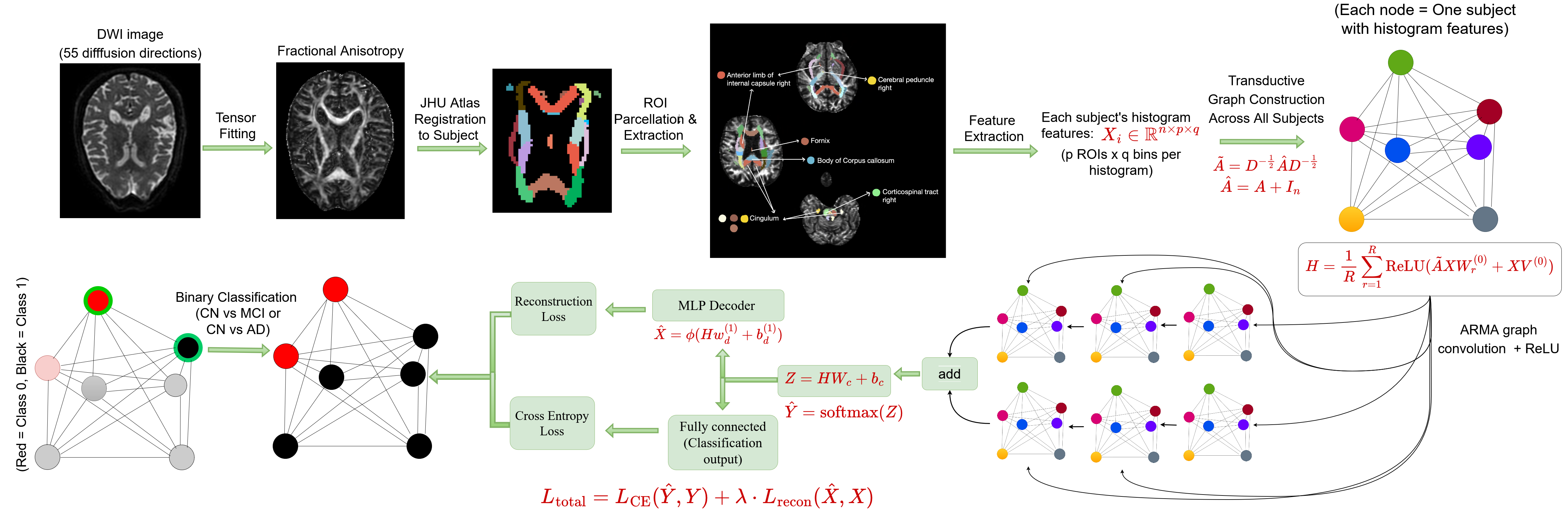
Pipeline: DWI → Tensor Fitting → FA maps → JHU Atlas Registration → ROI Parcellation (20-bin FA histograms from 9 white matter ROIs per subject) → Transductive Graph Construction ( = D−½ÂD−½) → ARMA Graph Convolution + ReLU + skip connection → MLP Decoder (reconstruction branch) + FC (classification branch) → Joint loss: LCE(Ŷ, Y) + λ · LMSE(X̂, X).
Contributions
- First GNN to simultaneously address over-smoothing and over-squashing in sparse-label neuroimaging graphs — ARMA spectral filtering prevents feature collapse while reconstruction regularisation preserves discriminative local structure.
- ARMA convolutional filters produce rational polynomial approximations of the graph spectrum — strictly more expressive than standard polynomial GCN filters — capturing long-range cortical dependencies without parameter explosion.
- Reconstruction-driven regularisation: an MLP decoder forces the ARMA encoder to preserve local features that pure classification objectives discard, preventing information collapse across deeper layers.
- Cohort-level transductive graph: the full dataset forms one connected graph with nodes encoding 20-bin FA histograms from 9 clinically relevant white matter ROIs and edges capturing inter-subject neuroanatomical similarity.
- Outperforms SVM, MLP, Random Forest, GCN, GAT, ChebNet, and AE-GCN across 90-10, 70-30, and 50-50 splits with 20-fold cross-validation on ADNI and NIFD datasets.
Results
Evaluated on ADNI (133 CN, 167 MCI, 88 AD — Siemens scanners) and NIFD (98 FTD, 48 healthy controls) with 20-fold cross-validation across three train-test splits. ARMARecon achieves 98.3% accuracy for CN vs. MCI and 99.7% accuracy for CN vs. AD (AUC = 1.0) — more than 3% above all GCN, GAT, and ChebNet baselines. The joint classification and reconstruction objective yields representations that are both discriminative and structurally faithful to the underlying neuroanatomy, enabling robust generalisation in low-label regimes.
BibTeX
@inproceedings{abburi2026isbi,
title = {ARMARecon: ARMA Convolutional Filter Based GNN for
Neurodegenerative Dementia Classification},
author = {Abburi, VSS Tejaswi and Singhal, Ananya and
Shigwan, Saurabh J. and Kumar, Nitin},
booktitle = {International Symposium on Biomedical Imaging (ISBI)},
address = {London, UK},
year = {2026}
}