- High b-value DWI (b ≥ 5000 s/mm²) is essential for probing restricted diffusion in tumour microstructure and axonal diameter estimation — but SNR degrades catastrophically, making denoising a clinical prerequisite.
- Fixed-kernel MPPCA is fundamentally at odds with structural heterogeneity: a large kernel suppresses noise in homogeneous white matter but simultaneously blurs sharp tumour–parenchyma boundaries critical for surgical planning.
- Existing adaptive methods (DESIGNER's adaptive patching) select voxels by spatial proximity and signal similarity — but do not leverage gradient-based structural information, leaving boundary-preserving denoising unsolved.
- A voxel-wise kernel strategy that reads local gradient complexity enables simultaneous aggressive denoising in homogeneous regions and conservative denoising at boundaries — without manual parameter tuning or retraining.
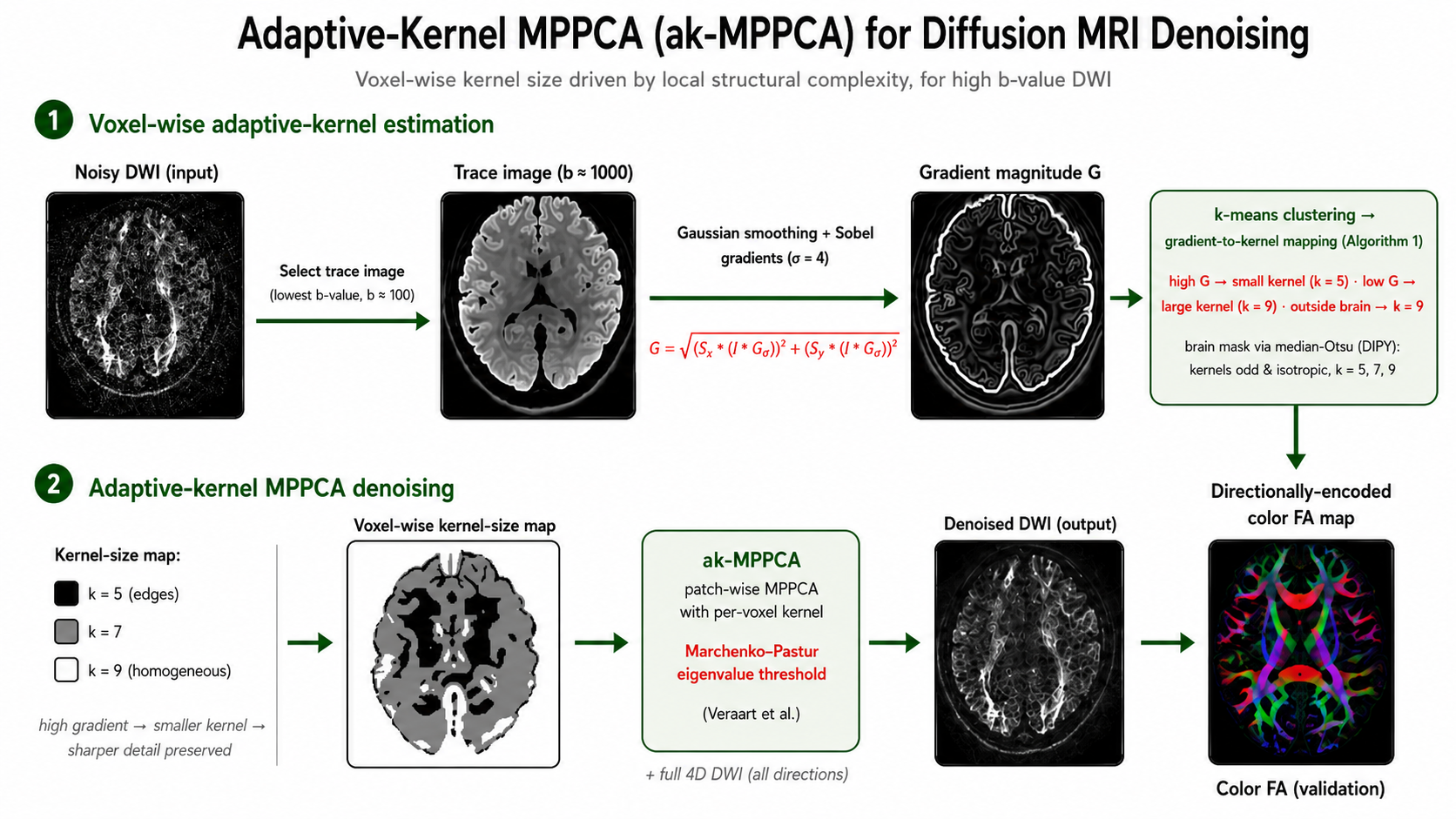
Pipeline: High b-value DWI stack → trace image at lowest b ≥ 100 → Sobel gradient magnitude with Gaussian smoothing (σ=4) → k-means clustering of voxel-wise gradient values into K bins → monotonic kernel assignment (high gradient → small kernel kl=5, low gradient → large kernel ku=9) → per-voxel odd-integer kernel size map → spatially-adaptive MPPCA denoising applied per-voxel → denoised DWI + colour FA maps.
- Gradient-based structural prior: Sobel edge detection on the trace image from the lowest available b-value (b ≥ 100) quantifies local tissue complexity, providing a hyperparameter-free, segmentation-free signal to drive per-voxel kernel selection.
- Gradient-to-kernel mapping algorithm: k-means clustering of brain-masked gradient magnitudes into K discrete bins with monotonic assignment to odd-integer MPPCA kernel sizes — high gradient → small kernel (preserves boundaries), low gradient → large kernel (maximises SNR gain). Voxels outside the brain mask assigned ku.
- ak-MPPCA: full integration of the per-voxel kernel map into the MPPCA pipeline, maintaining all random-matrix-theory noise estimation and eigenvalue thresholding principles from Veraart et al. while replacing the fixed patch with an adaptive one.
- Evaluated on 3 HCP (MGH-USC) subjects at b = 5000 and 10000 s/mm²; outperforms NYU-MPPCA, DIPY-MPPCA (kernel sizes 5, 7, 9), and DESIGNER adaptive patching in both DWI visual clarity and colour FA map accuracy — without any kernel size hyperparameter.
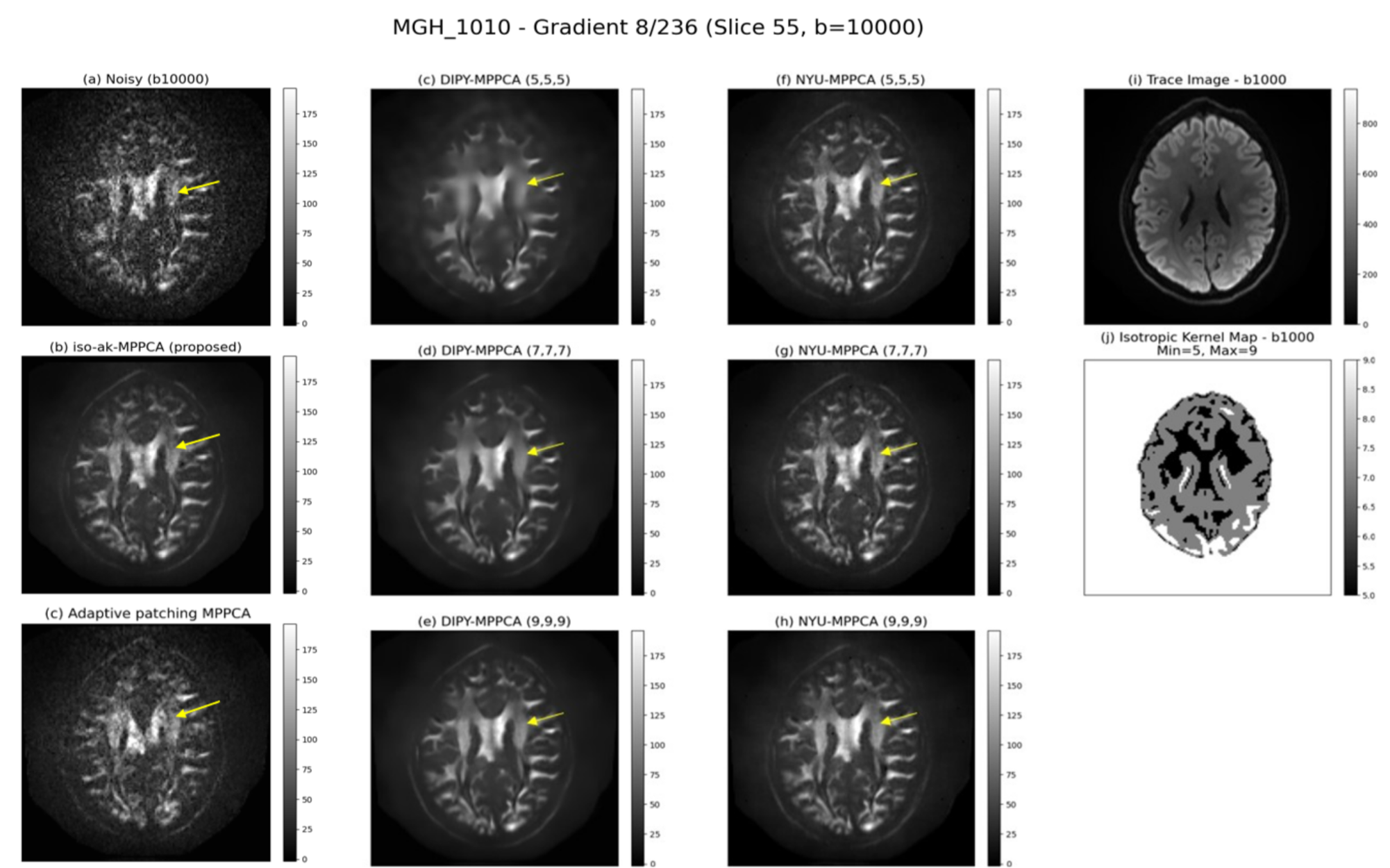
MGH-1010 (b=10000 s/mm²): (a) noisy DWI · (b) ak-MPPCA proposed · (c) adaptive patching · (d–f) DIPY-MPPCA at 5/7/9 · (g–i) NYU-MPPCA at 5/7/9 · (j) trace image · (k) voxel-wise kernel map. Yellow arrows show structural detail preserved by proposed method.
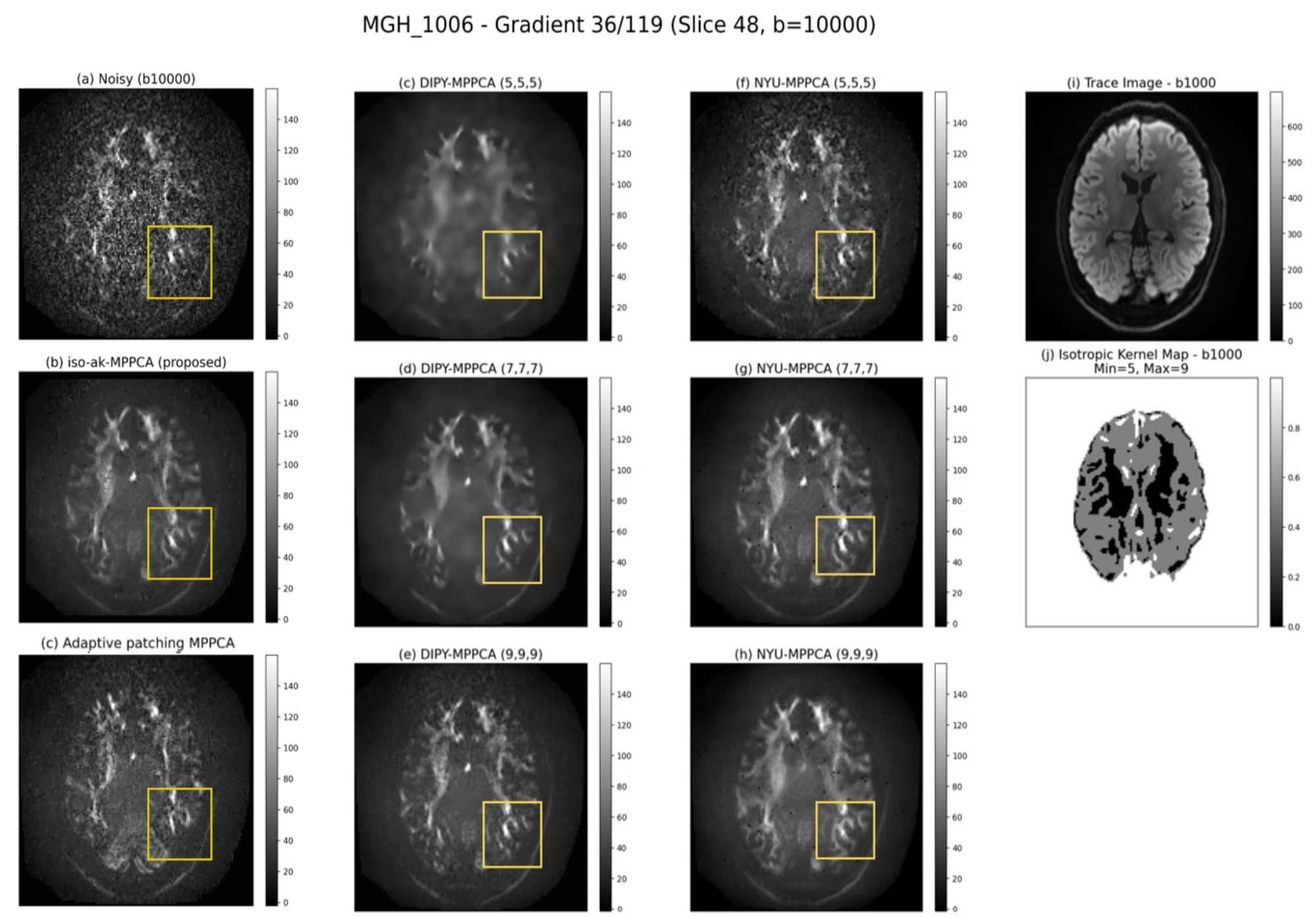
MGH-1006 (b=10000 s/mm²): Highlighted regions (yellow boxes) show where ak-MPPCA suppresses noise without blurring the boundary structure that fixed-size methods lose at kernel size 9.
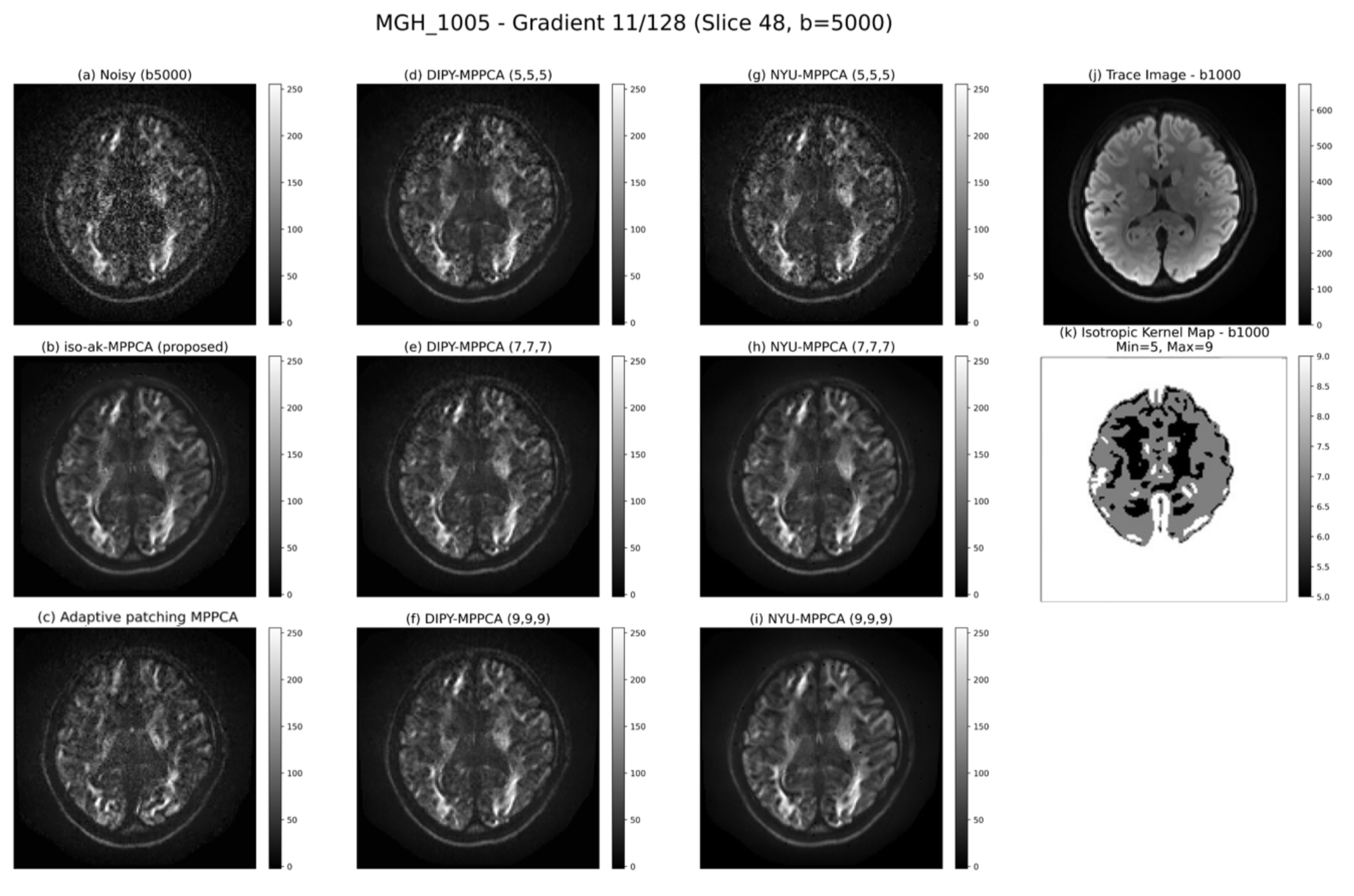
MGH-1005 (b=5000 s/mm²): At lower b-value, ak-MPPCA maintains cleaner DWI than all baselines while the adaptive kernel map correctly identifies cortical boundary regions for conservative denoising.
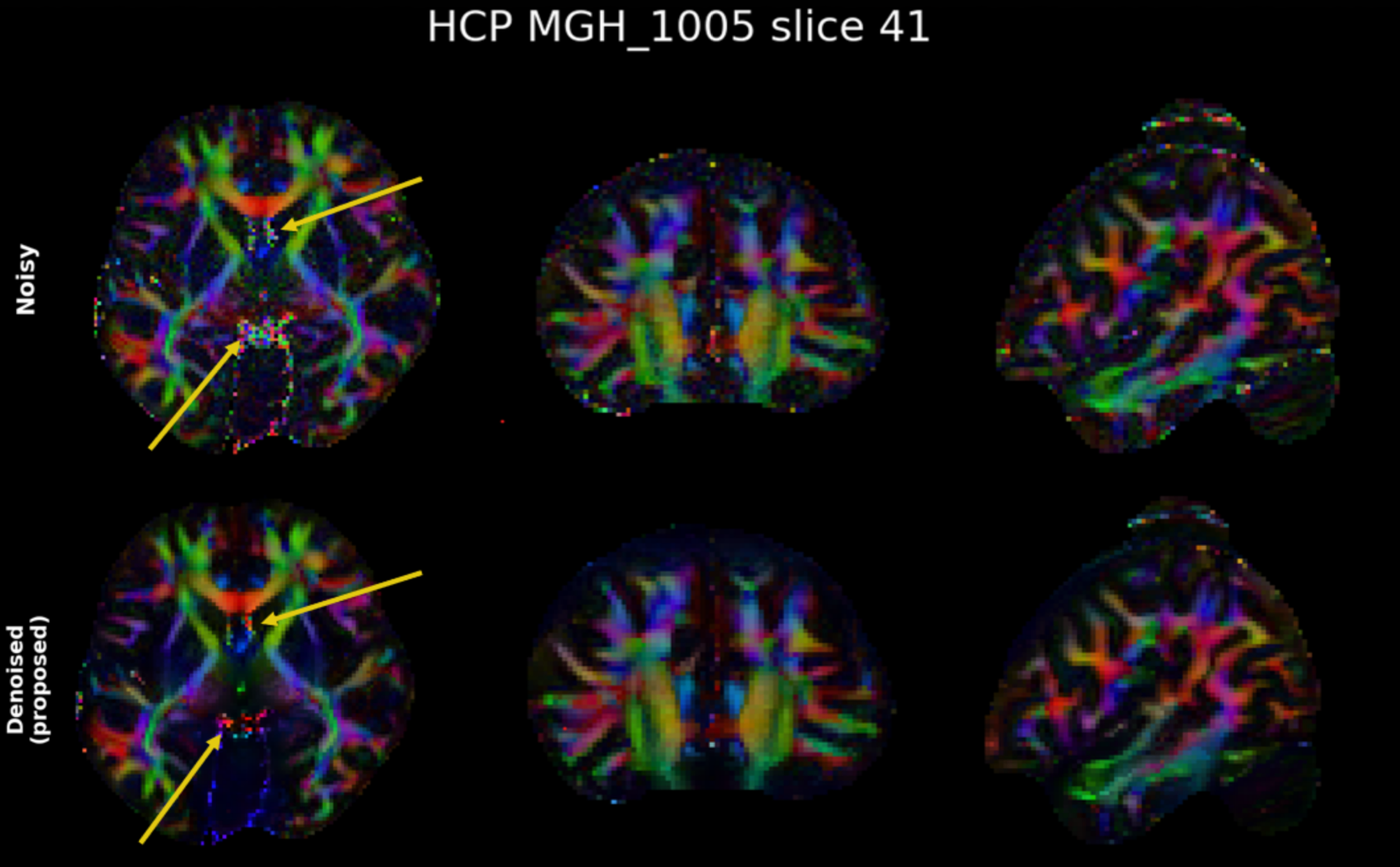
Slice 41: Noisy (top) vs. ak-MPPCA denoised (bottom). Directional coherence restored in crossing-fibre regions.
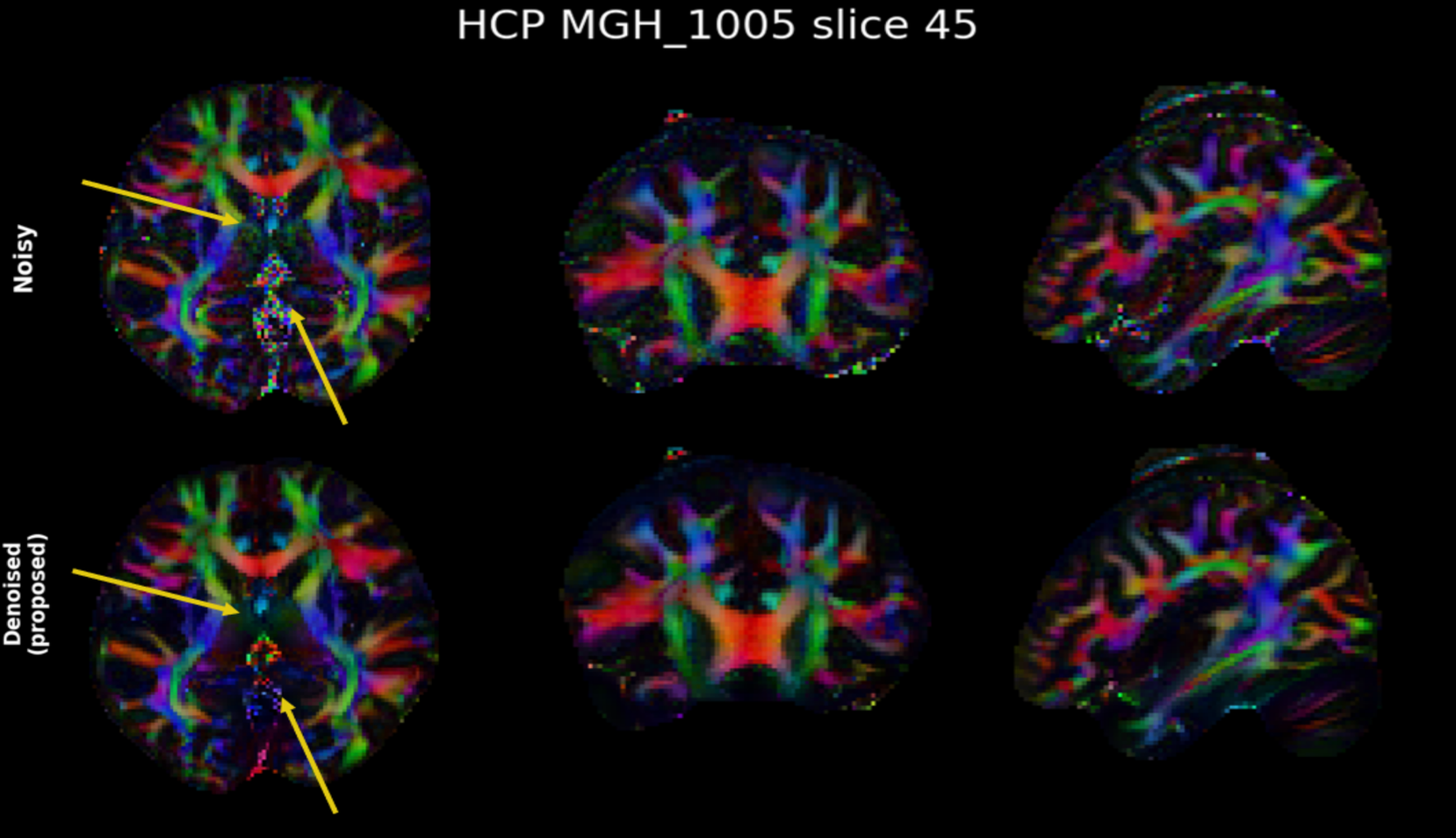
Slice 45: Yellow arrows mark regions where ak-MPPCA recovers clean diffusion orientation from heavily noisy DWI.
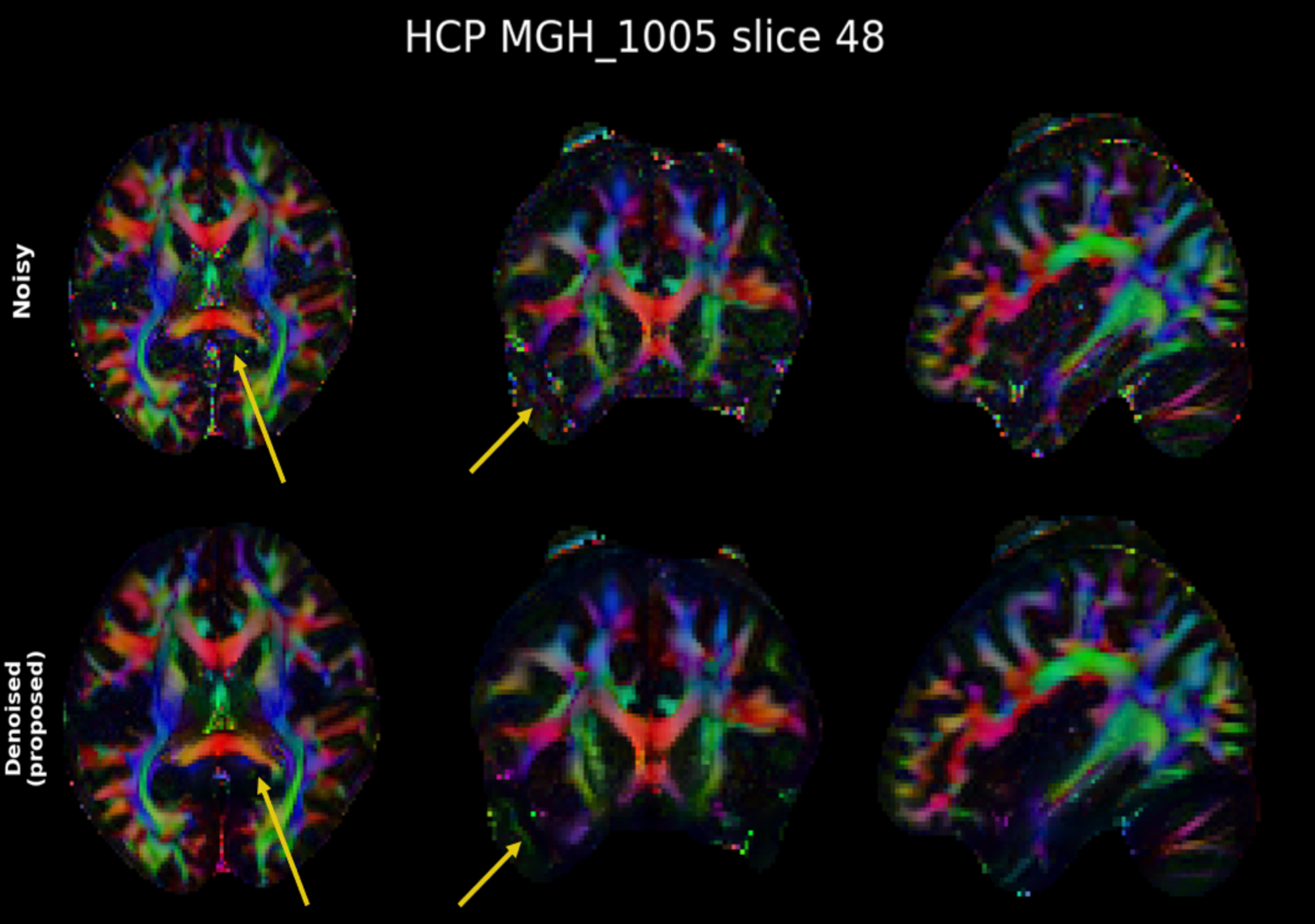
Slice 48: Deep white matter tracts show strong directional recovery after ak-MPPCA denoising.